
University certificate







The world's largest faculty of engineering”
Introduction to the Program
Advance in your professional career with a specialization that will provide you with all the necessary knowledge about Robotics and Industry 4.0”

Robots can make decisions and act autonomously, taking into account all the information from the environment, whether acquired by sensors or not. The engineering professionals bring to the development and creation phase all their knowledge in this field, with a mastery of algorithms, which allow the proper planning of tasks and movements.
This Postgraduate diploma focuses on the complex algorithmic world to analyze the main problems in the autonomy and movements of the robot, applying the most optimal strategies to solve them. With an eminently practical approach, the students of this program will approach an industry that also requires in-depth knowledge of the techniques that enable perception and vision systems.
Likewise, in this program, the engineering professionals will be accompanied by a teaching staff specialized in this field that will provide the latest technical advances achieved in the process of simultaneous localization and mapping, the so-called SLAM. In this way, students are faced with an extensive program where they can obtain a broad learning in a field of Robotics that demands more and more qualified professionals.
This program is an opportunity for students who want a specialization, which allows flexibility when accessing the syllabus. Thus, TECH offers in this Postgraduate diploma a complete program from day one with downloadable multimedia content to be viewed at any time and a Relearning system, based on repetition, which will facilitate learning.
A 100% online program that adapts to you. Access it at any time and with just a device with an internet connection”
This Postgraduate diploma in Robot Navigation Systems contains the most complete and up-to-date program on the market. The most important features include:
- Development of case studies presented by experts in robotic engineering
- The graphic, schematic, and practical contents with which they are created, provide scientific and practical information on the disciplines that are essential for professional practice
- Practical exercises where self-assessment can be used to improve learning
- Its special emphasis on innovative methodologies
- Theoretical lessons, questions to the expert, debate forums on controversial topics, and individual reflection assignments
- Content that is accessible from any fixed or portable device with an Internet connection
Register now and learn more about the latest techniques in optical sensor optimization for Robotics”
The program’s teaching staff includes professionals from the sector who contribute their work experience to this educational program, as well as renowned specialists from leading societies and prestigious universities.
Its multimedia content, developed with the latest educational technology, will provide the professional with situated and contextual learning, i.e., a simulated environment that will provide an immersive education programmed to learn in real situations.
The design of this program focuses on Problem-Based Learning, by means of which the professionals must try to solve the different professional practice situations that are presented throughout the program. For this purpose, the student will be assisted by an innovative interactive video system created by renowned experts.
The Relearning teaching method and multimedia content will allow you to reach your goals more easily. Click and enroll now"

Design more advanced digital image processing algorithms with this Postgraduate diploma"
Syllabus
The syllabus of this Postgraduate diploma has been designed by a team of professionals with extensive experience in Industry 4.0. That is why this program is structured in 4 modules, where students will have a wide range of audiovisual material that will take them through the main concepts of design and modeling, algorithms, vision in Robotics or Simultaneous Mapping by means of Artificial Vision techniques. Essential reading and case studies of real examples provided by the teaching staff complete this program. 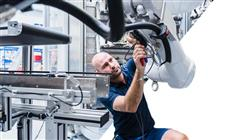
You have at your fingertips the main tools to create robot designs and modeling. Click and specialize”
Module 1. Robotics: Robot Design and Modeling
1.1. Robotics and Industry 4.0
1.1.1. Robotics and Industry 4.0
1.1.2. Application Fields and Use Cases
1.1.3. Sub-Areas of Specialization in Robotics
1.2. Robot Hardware and Software Architectures
1.2.1. Hardware Architectures and Real-Time
1.2.2. Robot Software Architectures
1.2.3. Communication Models and Middleware Technologies
1.2.4. Robot Operating System (ROS) Software Integration
1.3. Mathematical Modeling of Robots
1.3.1. Mathematical Representation of Rigid Solids
1.3.2. Rotations and Translations
1.3.3. Hierarchical State Representation
1.3.4. Distributed Representation of the State in ROS (TF Library)
1.4. Robot Kinematics and Dynamics
1.4.1. Kinematics
1.4.2. Dynamics
1.4.3. Underactuated Robots
1.4.4. Redundant Robots
1.5. Robot Modeling and Simulation
1.5.1. Robot Modeling Technologies
1.5.2. Robot Modeling with URDF
1.5.3. Robot Simulation
1.5.4. Modeling with Gazebo Simulator
1.6. Robot Manipulators
1.6.1. Types of Manipulator Robots
1.6.2. Kinematics
1.6.3. Dynamics
1.6.4. Simulation
1.7. Terrestrial Mobile Robots
1.7.1. Types of Terrestrial Mobile Robots
1.7.2. Kinematics
1.7.3. Dynamics
1.7.4. Simulation
1.8. Aerial Mobile Robots
1.8.1. Types of Aerial Mobile Robots
1.8.2. Kinematics
1.8.3. Dynamics
1.8.4. Simulation
1.9. Aquatic Mobile Robots
1.9.1. Types of Aquatic Mobile Robots
1.9.2. Kinematics
1.9.3. Dynamics
1.9.4. Simulation
1.10. Bioinspired Robots
1.10.1. Humanoids
1.10.2. Robots with Four or More Legs
1.10.3. Modular Robots
1.10.4. Robots with Flexible Parts (Soft-Robotics)
Module 2. Robot Planning Algorithms
2.1. Classical Planning Algorithms
2.1.1. Discrete Planning: State Space
2.1.2. Planning Problems in Robotics. Robotic Systems Models
2.1.3. Classification of Planners
2.2. The Trajectory Planning Problem in Mobile Robots
2.2.1. Forms of Environment Representation: Graphs
2.2.2. Search Algorithms in Graphs
2.2.3. Introduction of Costs in Networks
2.2.4. Search Algorithms in Heavy Networks
2.2.5. Algorithms with any Angle Approach
2.3. Planning in High Dimensional Robotic Systems
2.3.1. High Dimensionality Robotics Problems: Manipulators
2.3.2. Direct/Inverse Kinematic Model
2.3.3. Sampling Planning Algorithms PRM and RRT
2.3.4. Planning Under Dynamic Constraints
2.4. Optimal Sampling Planning
2.4.1. Problem of Sampling-Based Planners
2.4.2. RRT Probabilistic Optimality Concept
2.4.3. Reconnection Step: Dynamic Constraints
2.4.4. CForest. Parallelizing Planning
2.5. Real Implementation of a Motion Planning System
2.5.1. Global Planning Problem. Dynamic Environments
2.5.2. Cycle of Action, Sensorization. Acquisition of Information from the Environment
2.5.3. Local and Global Planning
2.6. Coordination in Multi-Robot Systems I: Centralized System
2.6.1. Multirobot Coordination Problem
2.6.2. Collision Detection and Resolution: Trajectory Modification with Genetic Algorithms
2.6.3. Other Bio-Inspired Algorithms: Particle Swarm and Fireworks
2.6.4. Collision Avoidance by Choice of Maneuver Algorithm
2.7. Coordination in Multi-Robot Systems II: Distributed Approaches I
2.7.1. Use of Complex Objective Functions
2.7.2. Pareto Front
2.7.3. Multi-Objective Evolutionary Algorithms
2.8. Coordination in Multi-Robot Systems III: Distributed Approaches II
2.8.1. Order 1 Planning Systems
2.8.2. ORCA Algorithm
2.8.3. Addition of Kinematic and Dynamic Constraints in ORCA
2.9. Decision Planning Theory
2.9.1. Decision Theory
2.9.2. Sequential Decision Systems
2.9.3. Sensors and Information Spaces
2.9.4. Planning for Uncertainty in Sensing and Actuation
2.10. Reinforcement Learning Planning Systems
2.10.1. Obtaining the Expected Reward of a System
2.10.2. Mean Reward Learning Techniques
2.10.3. Inverse Reinforcement Learning
Module 3. Artificial Vision Techniques in Robotics: Image Processing and Analysis
3.1. Computer Vision
3.1.1. Computer Vision
3.1.2. Elements of a Computer Vision System
3.1.3. Mathematical Tools
3.2. Optical Sensors for Robotics
3.2.1. Passive Optical Sensors
3.2.2. Active Optical Sensors
3.2.3. Non-Optical Sensors
3.3. Image Acquisition
3.3.1. Image Representation
3.3.2. Color Space
3.3.3. Digitizing Process
3.4. Image Geometry
3.4.1. Lens Models
3.4.2. Camera Models
3.4.3. Camera Calibration
3.5. Mathematical Tools
3.5.1. Histogram of an Image
3.5.2. Convolution
3.5.3. Fourier Transform
3.6. Image Preprocessing
3.6.1. Noise Analysis
3.6.2. Image Smoothing
3.6.3. Image Enhancement
3.7. Image Segmentation
3.7.1. Contour-Based Techniques
3.7.2. Histogram-Based Techniques
3.7.3. Morphological Operations
3.8. Image Feature Detection
3.8.1. Point of Interest Detection
3.8.2. Feature Descriptors
3.8.3. Feature Matching
3.9. 3D Vision Systems
3.9.1. 3D Perception
3.9.2. Feature Matching between Images
3.9.3. Multiple View Geometry
3.10. Computer Vision-Based Localization
3.10.1. The Robot Localization Problem
3.10.2. Visual Odometry
3.10.3. Sensory Fusion
Module 4. Visual SLAM. Robot Localization and Simultaneous Mapping by Artificial Vision Techniques
4.1. Simultaneous Localization and Mapping (SLAM)
4.1.1. Simultaneous Localization and Mapping. SLAM
4.1.2. SLAM Applications
4.1.3. SLAM Operation
4.2. Projective Geometry
4.2.1. Pin-Hole Model
4.2.2. Estimation of Intrinsic Parameters of a Chamber
4.2.3. Homography, Basic Principles and Estimation
4.2.4. Fundamental Matrix, Principles and Estimation
4.3. Gaussian Filters
4.3.1. Kalman Filter
4.3.2. Information Filter
4.3.3. Adjustment and Parameterization of Gaussian Filters
4.4. Stereo EKF-SLAM
4.4.1. Stereo Camera Geometry
4.4.2. Feature Extraction and Search
4.4.3. Kalman Filter for Stereo SLAM
4.4.4. Stereo EKF-SLAM Parameter Setting
4.5. Monocular EKF-SLAM
4.5.1. EKF-SLAM Landmark Parameterization
4.5.2. Kalman Filter for Monocular SLAM
4.5.3. Monocular EKF-SLAM Parameter Tuning
4.6. Loop Closure Detection
4.6.1. Brute Force Algorithm
4.6.2. FABMAP
4.6.3. Abstraction Using GIST and HOG
4.6.4. Deep Learning Detection
4.7. Graph-SLAM
4.7.1. Graph-SLAM
4.7.2. RGBD-SLAM
4.7.3. ORB-SLAM
4.8. Direct Visual SLAM
4.8.1. Analysis of the Direct Visual SLAM Algorithm
4.8.2. LSD-SLAM
4.8.3. SVO
4.9. Visual Inertial SLAM
4.9.1. Integration of Inertial Measurements
4.9.2. Low Coupling: SOFT-SLAM
4.9.3. High Coupling: Vins-Mono
4.10. Other SLAM Technologies
4.10.1. Applications Beyond Visual SLAM
4.10.2. Lidar-SLAM
4.10.2. Range-only SLAM

Master the different applications of Simultaneous Localization and Mapping (SLAM) with this Postgraduate diploma"
Postgraduate Diploma in Robot Navigation Systems.
Are you passionate about robotics and would like to learn how to design autonomous navigation systems for robots? TECH Global University's Postgraduate Diploma in Robot Navigation Systems is just what you need to take a big leap in your robotics engineering career. In this program, you'll learn the theoretical and practical fundamentals needed to design autonomous navigation systems and take your skills to the next level. Hybrid learning classes will allow you the flexibility to study online and attend hands-on sessions at the TECH Global University campus.
Develop a solid understanding of autonomous navigation systems from TECH.
During the program, you'll learn the fundamental concepts of autonomous navigation systems, including simultaneous localization and mapping (SLAM) techniques, trajectory planning, environmental sensing and motion control. You will also explore the latest advances in mobile robotics and autonomous navigation systems. As a graduate of this program, you'll be prepared to design autonomous navigation systems for mobile robots in a wide range of applications, from exploring unfamiliar terrain to package delivery and industrial process automation. Join the future of robotics with TECH Global University's Postgraduate Diploma in Robot Navigation Systems!